Personalization
When everything feels like it's about you--or, me, really.

One of the most common cognitive distortions is personalization—the belief that we are the cause of external events, especially negative ones. It’s the mental habit of assuming responsibility or blame for things outside our control.
It sounds like:
“They didn’t respond to my message because I must have said something wrong.”
“That person seemed upset—what did I do?”
“The meeting went badly because I didn’t speak up.”
This distortion doesn’t just affect our relationships. It can quietly undermine our efforts to build mastery. When we’re learning something new—whether it’s a skill, a habit, or a way of being—we’re bound to stumble. But if we personalize every setback, we risk interpreting those stumbles as proof that we’re not good enough, not smart enough, not worthy.
A Note on Taking Things Personally v. Personalization
No, it does not serve us to personalize things that aren’t ours to own but, yes, sometimes we can and need to take things personally. That’s the tricky part.
Sometimes feedback does apply. Sometimes the shoe fits. But acknowledging that doesn’t mean turning everything into self-blame. It means knowing when something is situational and shared—when it’s about human patterns, not personal failings.
Taking something personally is an emotional reflex—an instinctive response to feeling hurt, judged, or rejected.
Taking something personally says, “That stung.”Personalization, however, is a pattern of thinking—an inaccurate belief that events or others’ emotions are caused by us. Personalization says, “It happened because of me.”
The first one feels sharp in the moment; the second one lingers in our mental background. The trick is having the wherewithal to discern between them.
A Recent Example of Personalization: When the Dentist Hits a Nerve
After my mother died, after years of chaos (which will be stories for other posts), I finally had the space to turn my attention to my father. He has vascular dementia which has affected some of his memory but more of his executive function, like decision making and sorting out details. He now lives with my partner and me. He doesn’t require hands-on care, but more of what are referred to as the instrumental activities of daily living (IADLs). Those include doing things like making sure there is food, his bills are paid, he has—and takes—his meds, that he can watch his shows whatever streaming platform they’re on. He can’t drive, he can’t live alone, he shouldn’t cook, but he can do a lot to take care of himself.
One day last summer—after Mom’s funeral in June, after buying a new house in July, after moving Dad in with us in August—when I’d finally had a chance to schedule a dental visit for him, his dentist made a comment. Actually, it was probably more of a diagnosis. She said something about how not seeing him for so long would likely result in him losing some teeth. It wasn’t a judgment, just a clinical observation. But I was crestfallen. I replied, “I did the best I could.”
Woof. Andy. Flag on the play. That passive-aggression was uncalled-for.
I fact-checked it in real time:
She hadn’t aimed the comment at me.
She didn’t deserve my defensive response.
And I didn’t deserve the weight of it either.
But my window of tolerance had been closed for a long time. I had nothing left.
That moment was a perfect storm of personalization, emotional exhaustion, and ambiguous meaning. I didn’t know if the comment was personal or not (of course it wasn’t), but my mind made it so. I filled in the blanks with guilt, grief, and the story I’d been telling myself: “I should have done more.”
Checking the Facts
I didn’t take the time to do it right away because I was dysregulated and unable to do more than notice that my brain had stepped out of line. But, later, I was able to go through it, perhaps even with my therapist (I want to give credit where credit is due). But I added some questions to round it out today.
Here’s the fact-checking in slow motion:
What did I assume was happening?
That my father needed to have his teeth pulled due to neglect and the dentist was blaming me.
Was that actually what happened?
No. The dentist made a clinical observation about the consequences of delayed care and I personalized it. She said they might need to pull some—she did not say that they would.
Could I have possibly caused my 78-year-old Dad’s teeth to become worse and need to be pulled?
No. His dental health is the result of many factors—age, genetics, his own choices, and yes, the chaos of recent years. I brought him to the dentist when I could, when he said he needed to go.
Did I neglect my father while my mother took the majority of our attention?
No. They were living in an assisted living facility and almost all of his other needs were met. Dental trips took extra planning and I didn’t know he had any needs beyond the usual cleanings.
What are other explanations for his dental needs?
Vascular dementia affects executive functioning—he may not have been managing his hygiene well. The stress of caregiving, grief, and transition meant dental care wasn’t top priority. And sometimes, teeth just fail with age. Really, he’s a human and so am I.
What might I have been trying to communicate when I responded like that?
That I had a story, too, that I was experiencing while we were in the dental office. I can remember in real-time trying to give myself grace by responding with something that was self-compassionate, but the reason I felt the need to say something at all is what we’re talking about here. Under usual circumstances, a response might have been, “Okay, what are our next steps?”
A Learning Opportunity
I got lucky that I caught myself. There are plenty of times when I don’t, but I’m working on it. Because I did, though, I was able to process it. By processing it, I get closer to remapping those old neural pathways.
As a teaser for Fact-Check Fridays to come, here’s a little game of “I Spy.” Beyond personalization, what other cognitive distortions starred in my example?
Here’s a handy graphic:
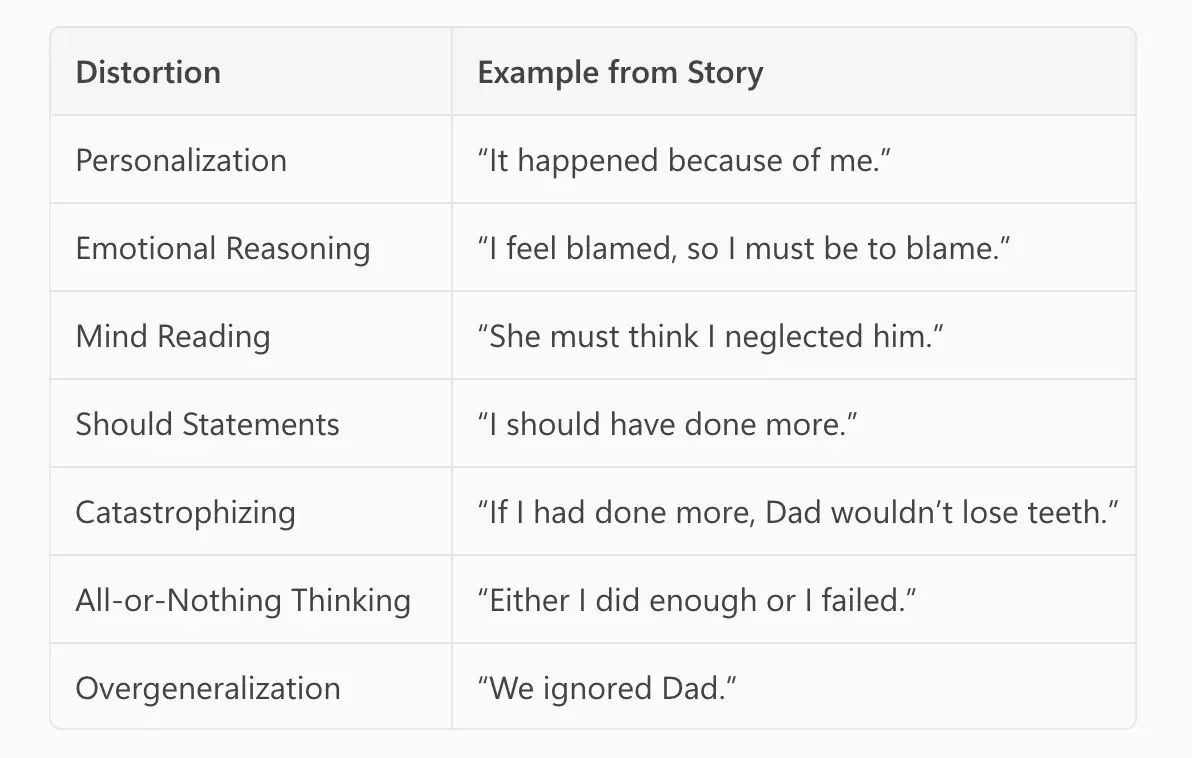
Whether mythic or microscopic, these cognitive distortions are attempts to reclaim control in the face of uncertainty. But when we cling to them too tightly—especially when they’re rooted in distortion—we suffer. We confuse possibility with proof. We mistake emotion for evidence.
And, in this case, I almost missed the point of what she said: that Dad needs dental care and I need to schedule it. Because, now, I actually am responsible for helping him get it. But by spiraling off into my distortions, I almost made it a self-fulfilling prophecy that I caused him to lose teeth. Now that’s a gut punch.
These are some tough neural pathways to remap, especially when something—or someone—means so much to us.
Exercise: Fact-Check Worksheet #1: Personalization
You guessed it: I designed a worksheet for you to take yourself through a similar fact-check as I did above. What would be even better is if you bring it to a therapy session or talked it through with a sponsor or other trusted person. When we share our stories, we learn out loud and have a sounding board. It only helps, as long as we’ve picked a good partner.