Wise Mind
Learning to be wise at any age.

When I first started treatment for my eating disorder, I cried in a way I can only describe as machine-gun crying. Loud. Percussive. Relentless. It was like my body had been holding in decades of emotion and finally found the release valve. I wasn’t raised to be emotional. I didn’t even know what emotions were, really. I had to use an emotions wheel in therapy just to point to what I might be feeling. Turns out, someone who’s been overweight her whole life feels a lot of anger. And a lot of sadness. So much sadness.
That’s when I was introduced to the concept of Wise Mind in Dialectical Behavioral Therapy (DBT). It was a revelation.
What Is Wise Mind?
In DBT, Wise Mind is the balanced state between Emotion Mind and Reasonable Mind. Marsha Linehan, the mind behind Wise Mind, gives every person credit for having inherent wisdom. And from there, she developed the DBT program I went through. Twice. Here are the basics to Wise Mind:
Emotion Mind is when feelings run the show. Decisions are driven by mood, urges, and immediate reactions. They’re impulsive and can be overwhelming.
Reasonable Mind is all logic, facts, and reason. It’s where we plan, analyze, and problem-solve—but often at the cost of ignoring how we feel.
Wise Mind is the integration of both. It’s the calm, centered place where emotion and reason work together. It’s the “knowing” that comes from both the heart and the head. And it takes time and practice to find and use.
Before treatment, I lived almost entirely in Reasonable Mind. I intellectualized everything. I could analyze my behaviors, explain my trauma, and rationalize my choices—but I couldn’t feel them. I didn’t know how. So when I finally started to feel, it came out in a flood. Machine-gun crying.
When Do We Need Wise Mind?
Wise Mind isn’t a constant state that we live in all the time—it’s a valuable tool to use when emotions and reason pull in opposite directions or when we struggle.
If you’re in Reasonable Mind and function well, your focus might just need logic.
If you’re in Emotion Mind and experiencing no distress, sometimes it’s okay to fully feel.
But Wise Mind becomes essential during moments of conflict, stress, or decision-making that feels overwhelming. That’s when pausing to ask:
What am I thinking?
What am I feeling?
What would my Wise Mind say?
helps create a clear path forward with compassion and courage.
Why Wise Mind Matters
Learning to access Wise Mind is a form of neural remapping. Every time we pause, notice, and respond with compassion and clarity, we are not only changing our behavior but also strengthening new neural pathways in the brain. This means the brain learns to create better patterns of thinking and feeling that favor balance over extremes.
Mindfulness and DBT skills help in this process by training attention and emotional regulation. The simple act of pausing—stepping back from an automatic reaction to observe emotions and thoughts—actively rewires the brain, promoting stronger connections in areas responsible for self-control and emotional insight.
It’s not about perfection. It’s about practice. Progress.
When Emotion Mind Hides in Reasonable Mind’s Clothing
For a long time, I believed I didn’t operate in Emotion Mind—because I didn’t even know what emotions were. I couldn’t name them, didn’t feel them in a way I understood, and certainly didn’t express them. But here’s what I’ve come to realize:
Even though I couldn’t identify my emotions, my maladaptive behaviors were driven by them.
That’s the tricky thing: Emotion Mind doesn’t always look like crying or yelling. Sometimes it looks like control, perfectionism, or numbing. Sometimes it looks like “I’m fine” when you’re anything but. It can be silent, hidden, even intellectualized. But it’s still there, driving the bus.
Learning to recognize that—Oh, this isn’t logic; this is fear dressed up as logic—was a turning point. It helped me stop blaming myself and start getting curious. It helped me begin the work of remapping.
Is There a Disordered Mind?
Is there a fourth mind? Something I’ll loosely refer to as Disordered Mind? Maybe there already is and I just didn’t encounter it in my decades of therapy or years as editorial director at the Hazelden Betty Ford Foundation. It’s very possible.
It just seems like there should be. And I’m not talking about the Disease Model of Addiction that kind of gets at an externalization of the problem, but more of a containment where thoughts, emotions, and decisions are shaped by the symptoms of a mental health condition. That the mental health condition or disorders lead to or allow patterns that feel logical or emotionally true but are ultimately maladaptive or distorted.
When I was in the throes of my eating disorder, it made sense to me to diet and diet and diet to the point where my body didn’t know what to do, because of everything that made up my eating disorder. I logically needed to do that, or so I thought…or so we all think when we starve ourselves. I get sad just thinking about it.
I can also hear some of the things I used to tell myself when I didn’t want to quit drinking that seemed like Reasonable Mind, but were really Emotion Mind, I suppose:
“If I stay away from the hard stuff, I’ll be fine.”
“Calories from alcohol are better than calories from food—there isn’t fat in alcohol.”
“If I just go home to drink, I won’t be behind the wheel or a risk to anyone.”
Each statement ignored the ugly reality of what was actually happening. Each one was a lie…and lies are not wise.
What I was really saying was,
“I’m too scared to never drink again, so I’ll bargain with a half-truth until I screw it up again.”
“I need to drink or eat tonight to numb myself or make myself feel better.”
“I need to be where nobody will stop me from drinking as much as I want to.”
Every time I acted on one of my disorders’ symptoms, I wasn’t in Reasonable Mind. I wasn’t in Wise Mind. I was in Emotion Mind—even if I didn’t know it.
But my 48-year-old Wise Mind is wondering if I could be a little more lenient with myself right now and say that I was also in Disordered Mind, which had a time and a place and is in my past. Everything during Disordered Mind might be Emotion Mind, really. Everything after Disordered Mind can be a bit more predictable and mundane—back to the three minds that help us achieve wisdom as devised by Dr. Linehan. I’d love to hear what anyone thinks of this idea in the comments.
A Real-Life Wise Mind Check-In
Just the other day, I noticed my face was grimacing, my body tense, my mood dipping. Old me would’ve ignored it and reached for something maladaptive. New me pauses and asks: What’s going on here?
For example, when feeling overwhelmed by a sudden conflict or setback, instead of reacting impulsively, I check in with myself:
What am I feeling right now? (Emotion Mind)
What thoughts are running through my head? (Reasonable Mind)
What would my Wise Mind say—what is the balanced truth here?
Wise Mind Venn Diagram: Health Anxiety & Family History
Context: I’m feeling uneasy about going to see a rheumatologist. I had a hysterectomy earlier this year and haven’t had time to follow up on arthritis concerns. I’m aware of a strong family history of autoimmune conditions—arthritis (mother, maternal aunt, both grandmothers), psoriasis (father), and Crohn’s disease (maternal uncle). I’m not in terrible shape, but I’m worried. Writing it out in lists, this is what it looks like:
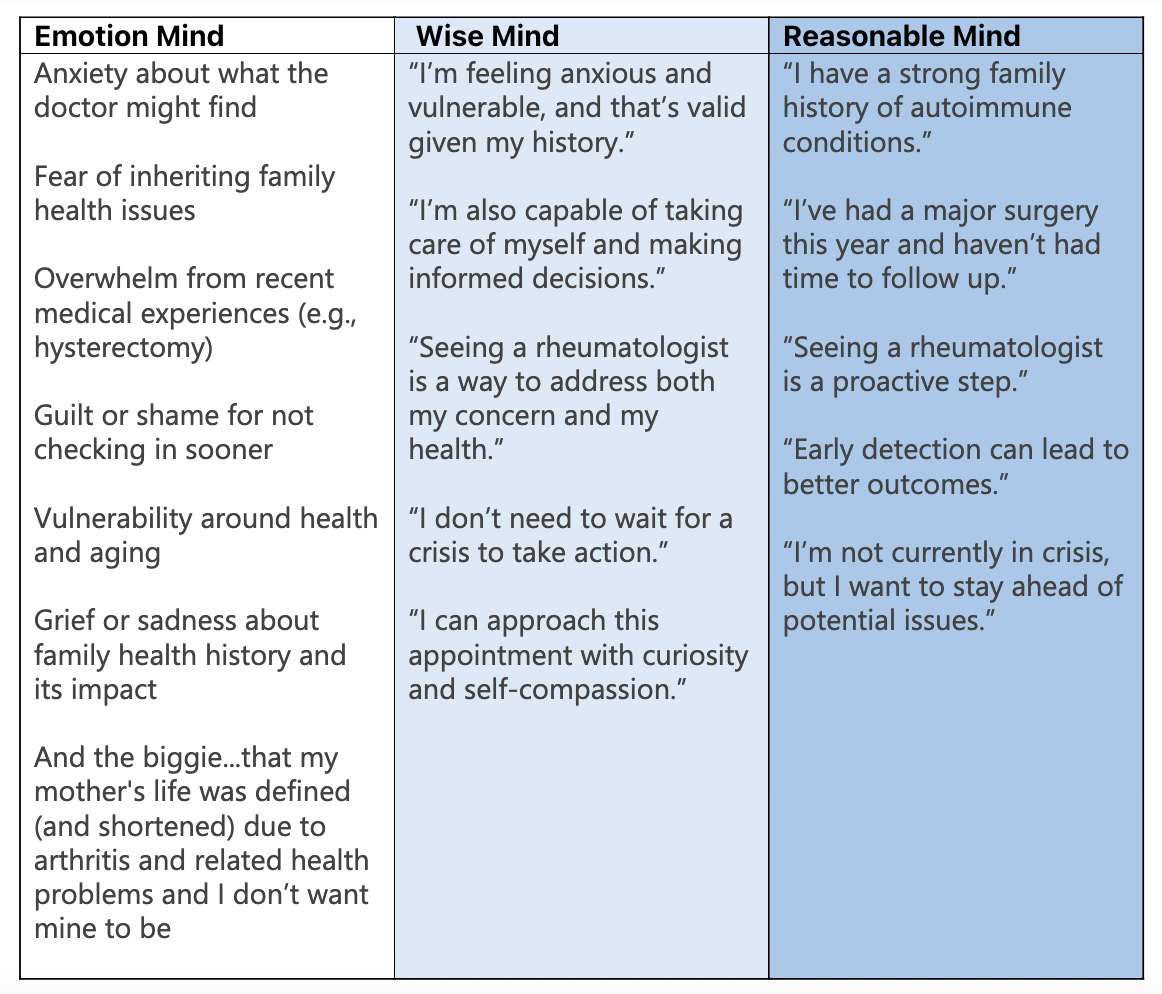
I know there are a lot of words here and it doesn’t exactly sound or feel natural, especially the Wise Mind list. But it’s not natural, yet. Doing this will help me to recognize fear mixed with frustration but also see that the situation is manageable. I might then choose to take a deep breath, step back emotionally, and respond thoughtfully rather than react impulsively. Every time I do it, it’ll become more and more natural and easy to do.
And I’ll own up to the Emotion Mind column sounding a bit more like frustration because that’s how a lot of my emotions come out first. This is me putting that frustration into words.
Note: In DBT group, we used to draw a Wise Mind Venn Diagram on the whiteboard:
Left Circle: Emotion Mind (What am I feeling?)
Right Circle: Reasonable Mind (What am I thinking?)
Middle Overlap: Wise Mind (What’s the balanced truth?)
The process of noticing, questioning, and responding mindfully lets me engage Wise Mind in real time. I tend to write a little more than what fits in circles (ahem, see above), but give it a try with the linked worksheet.
Worksheet: Accessing Wise Mind - Finding the Balance Within
This worksheet is designed to help you identify and access your Wise Mind—the calm, centered place where emotional intuition and rational thought meet. In this exercise, you’ll explore the patterns of your Emotion Mind and Rational Mind, and begin to notice when each one is leading. By tuning into your Wise Mind, you can make decisions that align with your values, even in moments of stress or uncertainty. Awareness is the first step toward inner balance—and toward responding rather than reacting.